Pointer declaration
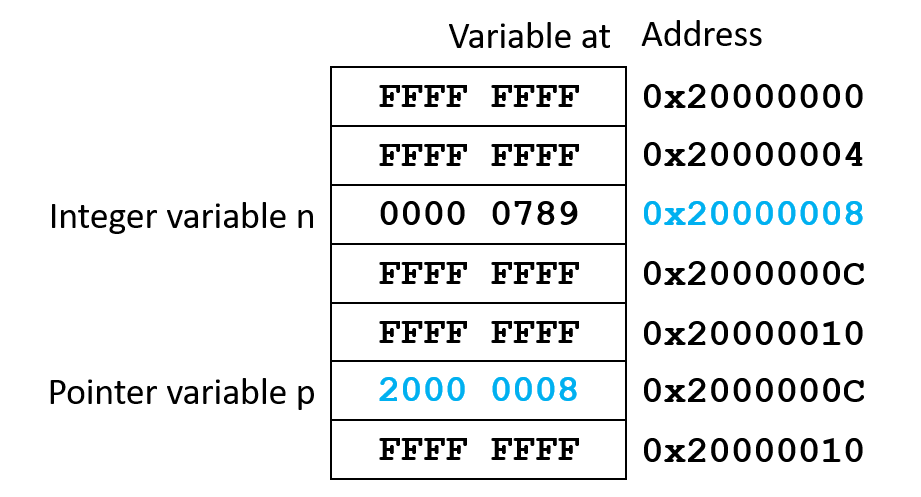
As any other variable, you need to declare a pointer. Furthermore, you have to initialize a pointer before you can use it.
You declare a pointer just like any other variable:
Syntax
type *name;
type can be any C type (such as char, int, or float for example).
name is the name of the pointer variable.
The * makes the variable a pointer.
Pointers are usually described as “a pointer to type”
Code example
int *myPointer        // declares a pointer named myPointer as an integer type

float *myOtherPointer // declares a pointer named myOtherPointer as a float type

myPointer = &myIntVar;        // assigns the memory address of myIntVar to myPointer

myOtherPointer = &myFloatVar; // assigns the memory address of myFloatVar to myOtherPointer
Creating pointer types with typedef
Syntax
typedef type *typeName;
Note
- A pointer variable can now be declared as type
typeNamewhich is a synonym fortype. - The * is no longer needed since
typeNameexplicitly identifies the variable as a pointer totype.
Code example
typedef int *intPointer; // Create a pointer to int type

intPointer p;            // Create pointer to int (without *)
                         // Equivalent to int *p;
Initialization
To set a pointer to point to another variable, we use the & operator (address of), and the pointer variable is used
without the dereference operator *:
p = &n;
This assigns the address of the variable n to the pointer p (p now points to n).
Note
pmust be declared to point to the type ofn(e.g.int n; int *p;).
Usage
When accessing the variable pointed to by a pointer, we use the pointer with the dereference operator *:
m = *p;
This assigns to the variable m, the value of what p is pointing to (n from the last example). Using *p, is the same as using the variable it points to (e.g. n).
In other words
Code example
int n, *p; // Create an integer variable and a pointer to an integer variable

p = &n;    // Assign the address of n to p
*p = 3;    // Equals to n = 3;
In the pointer world:
&nis a constant pointer which represents the address ofn. This address of n will never change.pis a variable pointer to int which can be assigned the address of any int any time.*prepresents the data pointed to bypand may be used anywhere you would usen.*is the dereference operator, also called the indirection operator.- When declaring a pointer,
*is used to indicate that the variable is a pointer rather than an ordinary variable.
Pointers at work
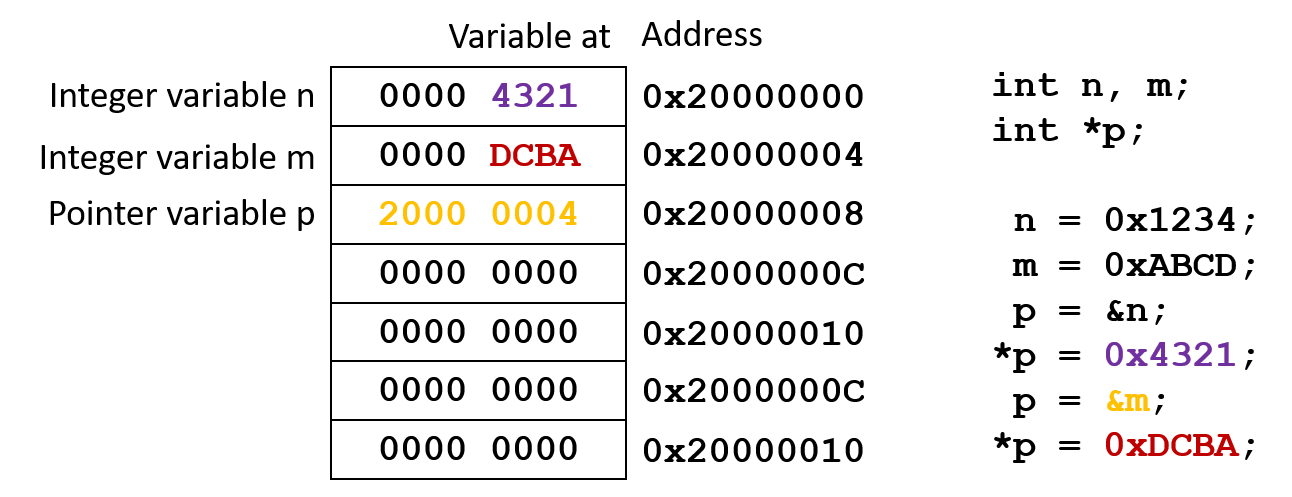
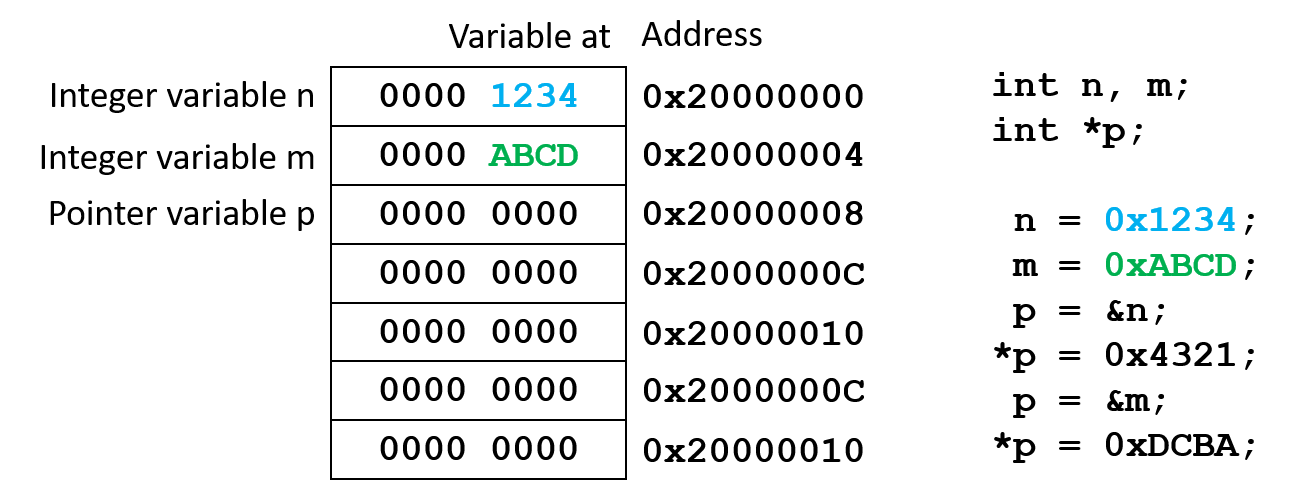
Consider the following code example. How is this working in an actual design?
Code example
int n, m;    // create two integer variables
int *p;      // create a pointer to an integer variable

 n = 0x1234; // assign 0x1234 to n
 m = 0xABCD; // assign 0xABCD to m
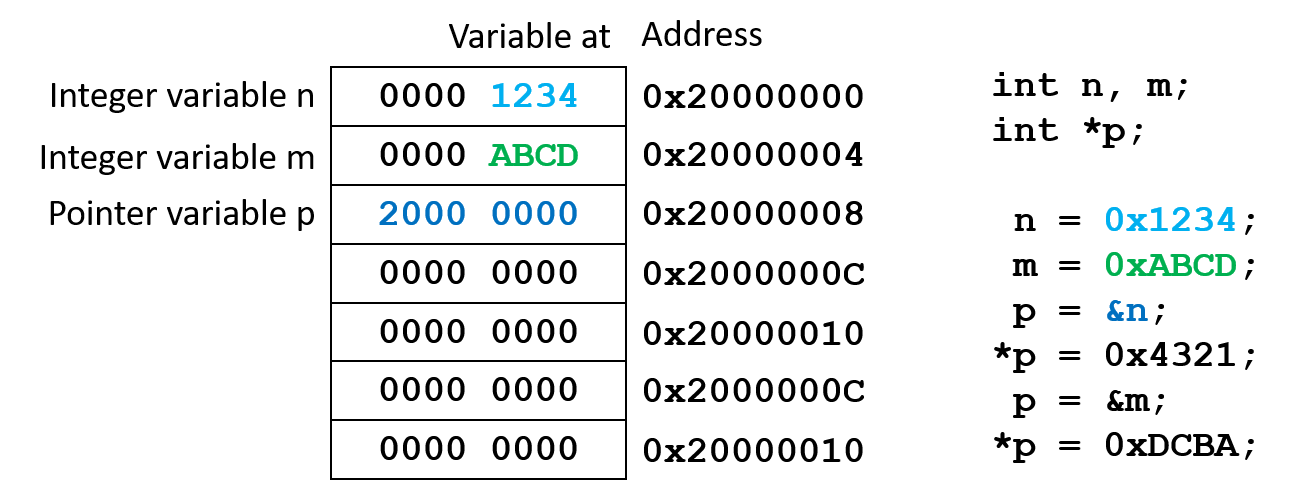
 p = &n;     // assign the address of n to p
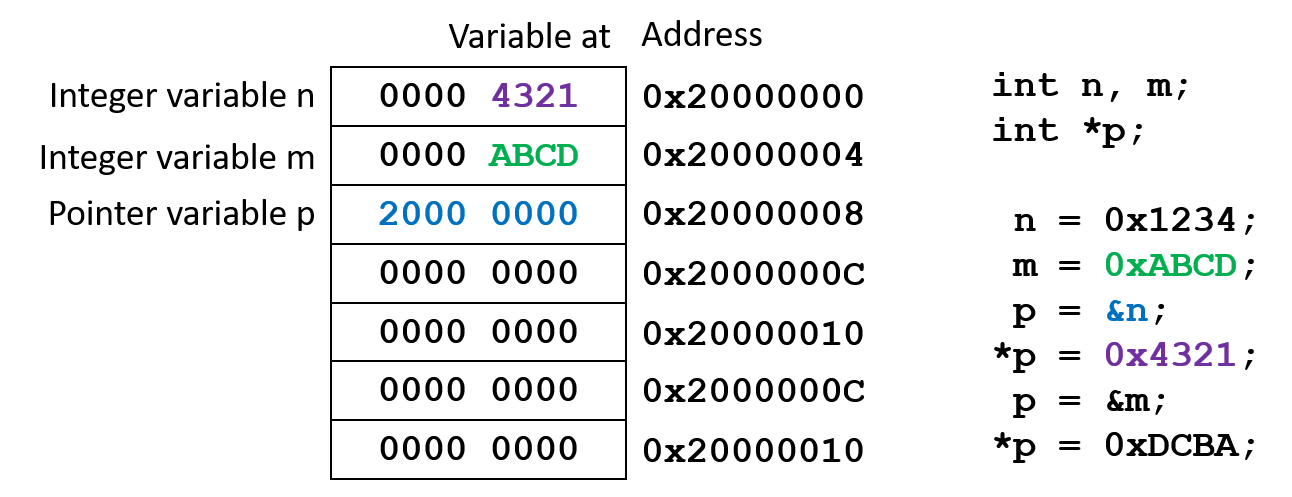
*p = 0x4321; // assign 0x4321 to n using *p
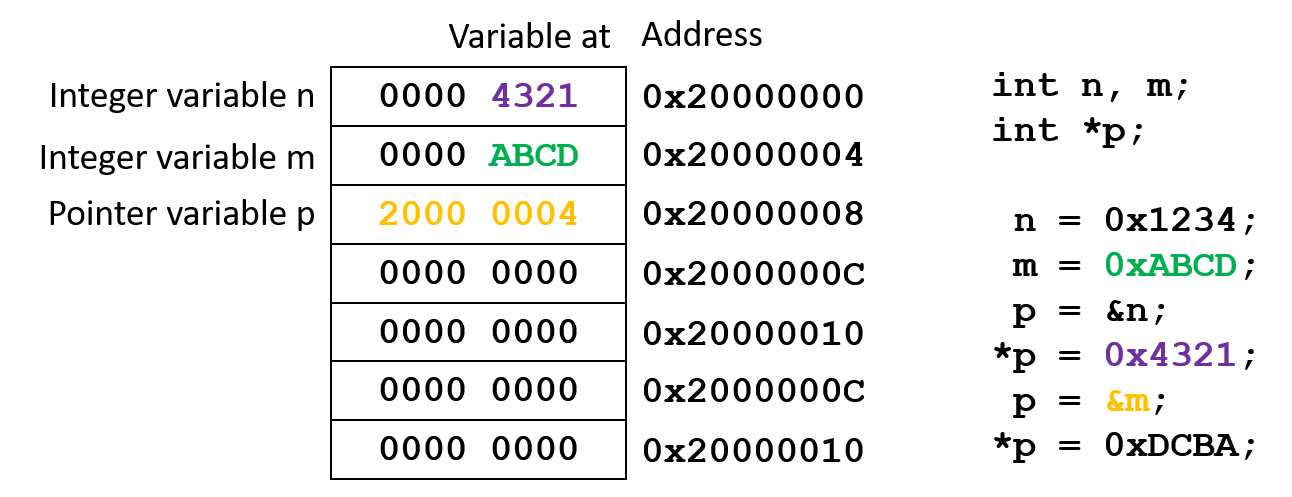
 p = &m;     // assign the address of m to p
*p = 0xDCBA; // assign 0xDCBA to m using *p
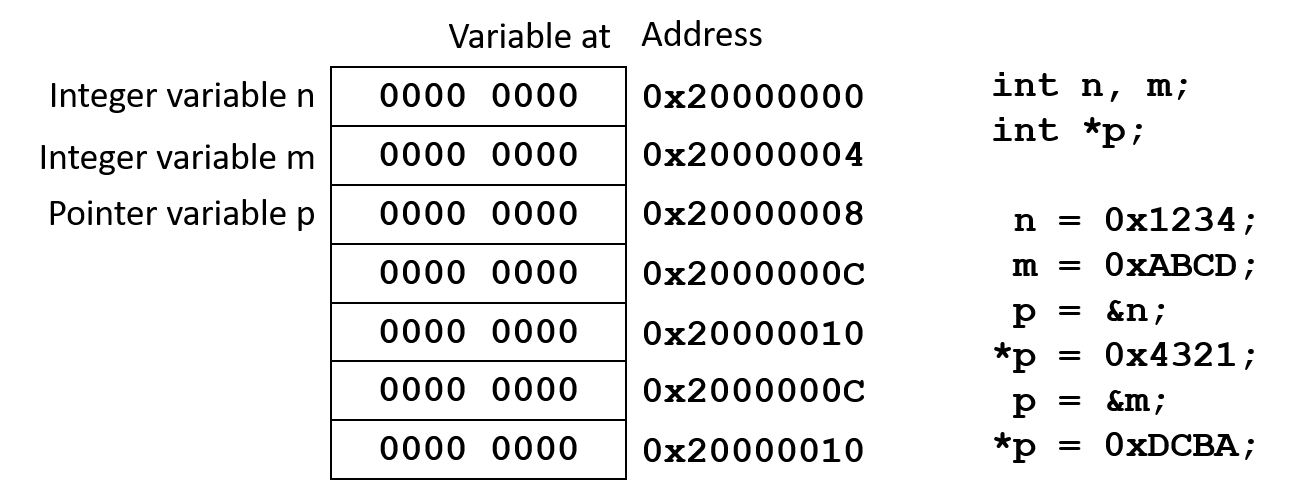
Zero-initialized RAM at program start:
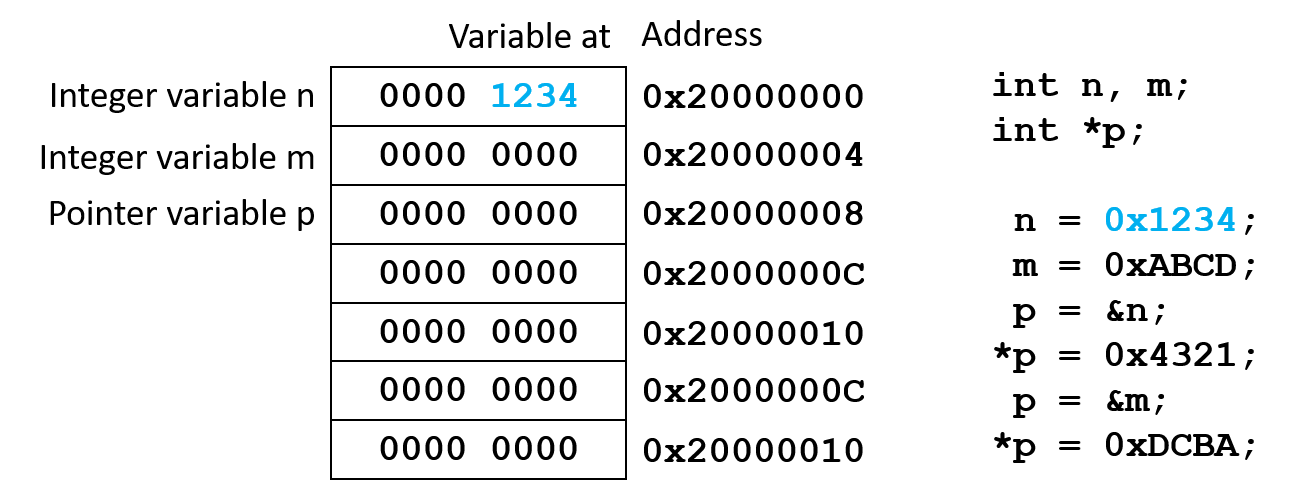
Assign 0x1234 to n:
Assign 0xABCD to m:
Assign the address of n to p:
Assign 0x4321 to n using *p:
Assign the address of m to p:
Assign 0xDCBA to m using *p: